Invest Cyprus представила результаты инвестиционной деятельности на Кипре за 2024 и 2025 годы на своем ежегодном собрании акционеров. Также ключевая для инвесторов организация сменила состав совета директоров. Все, что нужно знать о развитии сферы инвестиций – в статье.
Invest Cyprus представила результаты за 2024 и 2025 годы на своем ежегодном общем собрании акционеров 2026 года, состоявшемся в пятницу, 13 марта 2026 года. Результаты подтверждают значительное укрепление инвестиционных позиций Кипра, существенный вклад иностранных инвестиций в экономику и ключевую роль организации в привлечении иностранных инвестиций, а также постоянном расширении экономического присутствия иностранных компаний и инвесторов.
2024 год стал годом особенно высоких показателей: Кипр продемонстрировал валовой приток прямых иностранных инвестиций в размере 8,5 млрд евро, что примерно на 60% больше, чем в предыдущем году, заняв 2-е место в Европейском союзе и войдя в десятку лучших стран мира по объему прямых иностранных инвестиций на душу населения. Одновременно с этим 2,6 млрд евро инвестиций были направлены в технологический сектор (ИКТ), что укрепило быстрорастущую технологическую экосистему страны.
Invest Cyprus активно способствовала этому прогрессу, получив более 70 писем о намерениях инвестировать и реализовав 12 крупных инвестиций. Также благодаря Центру поддержки бизнеса более 420 компаний открыли свои представительства на Кипре.
Еще одной важной вехой стало первое всеобъемлющее исследование экономического влияния иностранных инвестиций, подготовленное Центром экономических исследований Кипрского университета. Согласно исследованию, приток новых иностранных инвестиций за один год составляет 3,3% ВВП и обеспечивает 4% занятости. Кроме того, исследование показало, что технологические компании, созданные благодаря иностранным инвестициям, вносят 11% в ВВП страны, подчеркивая роль иностранных инвестиций в создании новых секторов экономической деятельности в рамках реализации плана «Видение- 2035».
В 2025 году была реализована масштабная международная программа, включающая поездки президента Кипра в США и Канаду, а также визиты высокопоставленных бизнесменов и премьер-министра Индии.
Одновременно с этим были налажены важные стратегические партнерства, такие как создание Индийско-Греческо-Кипрского совета по бизнесу и инвестициям, формирование Совета по бизнесу и инвестициям между ОАЭ и Кипром, а также укрепление трехстороннего сотрудничества между Грецией, Египтом и Кипром.
В течение отчетного периода организация оказала поддержку примерно 800 существующим и потенциальным компаниям.
В 2026 году Invest Cyprus уделяет особое внимание международному продвижению страны в сотрудничестве с Financial Times, проводя ряд целевых мероприятий в Лондоне и Нью-Йорке, направленных на дальнейшее укрепление присутствия Кипра на рынках, имеющих важное стратегическое значение. Одновременно с этим в сотрудничестве с торгово-промышленной палатой Кипра готовится официальный визит президента Кипра в Индию.
Invest Cyprus вносит свой вклад в укрепление и поддержку кипрской оборонной промышленности посредством контактов и партнерств с компаниями из Индии, Франции, Италии, Великобритании и Испании, а также других стран, в сотрудничестве с министерством обороны и частным сектором.
Министр финансов Макис Керавнос в своем выступлении прокомментировал деятельность организации так: «Результаты, представленные на ежегодном общем собрании акционеров, подтверждают динамику развития Кипра как инвестиционного направления и важность работы, проводимой Invest Cyprus по продвижению страны за рубежом, содействию инвесторам и укреплению конкурентоспособности нашей экономики. Продолжение целенаправленной стратегии имеет решающее значение для поддержания этого позитивного курса».
Также на встрече был представлен обновленный состав совета директоров. Евгениос Евгениу остается председателем совета директоров Invest Cyprus, а Янгос Хаджияннис занимает должность вице-председателя. Новыми членами совета директоров организации стали Марилена Константину, Стилианос Парпаринос, Андреас Музуридис, Алики Серджи и Мелина Дионисиу. Новый состав совета директоров Invest Cyprus представлен ниже:
Президент: Евгениос Евгениу
Вице-президент: Янгос Хаджияннис
Члены:
Деметрис Спарсис
Марилена Константину
Анжела Панайоту
Ирини Йоргалла
Стилянос Парпаринос
Андреас Ассиотис
Андреас Музуридис
Яннис Хаджипараскевас
Христос Онуфриу
Алики Серджи
Мелина Дионисиу
Invest Cyprus – официальная организация Республики Кипр по содействию инвестициям и укреплению экономического развития страны. Ее миссия заключается в привлечении качественных иностранных инвестиций, поддержке международных компаний, желающих открыть представительства на Кипре, а также иностранных инвесторов, уже работающих здесь, чтобы они могли продолжать расширять свое присутствие в стране.
Текст подготовлен по материалам CBN.
Читайте также:

В понедельник, 9 марта, состоялась церемония открытия Кипрского института директоров и корпоративного управления (Cyprus Institute of Directors & Corporate Governance, или CyIoDCG). Программы будут ориентированы на действующих и будущих членов советов директоров, руководителей высшего звена и специалистов, стремящихся укрепить свои навыки корпоративного управления.
Мероприятие прошло в аудитории штаб-квартиры Bank of Cyprus в Никосии.
Главным докладчиком выступил профессор Людо Ван дер Хейден, заслуженный профессор кафедры корпоративного управления в INSEAD и приглашенный ученый IMD. В своем выступлении под названием «Почему управление всегда важно. Роль директоров» профессор Ван дер Хейден, среди прочего, подчеркнул критическую роль корпоративного управления как в периоды роста, так и в периоды кризиса.
В ходе мероприятия председатель CyIoDCG Кириакос Коккинос, бывший министр исследований, инноваций и цифровой политики, и вице-председатель CyIoDCG Димитра Калогиру, бывший председатель Кипрской комиссии по ценным бумагам и биржам (CySEC), представили видение и стратегическое направление CyIoDCG. Также была представлена программа сертификации и развития директоров института, направленная на укрепление навыков стратегического мышления и институциональной компетентности членов советов директоров и руководителей высшего звена.
Кроме того, выступили Кристиана Эротокриту, председатель финансового комитета парламента, Йоргос Теохаридис, нынешний председатель CySEC, Ирини Пики, министр при президенте, и Элени Неоклеус, главный специалист по соблюдению нормативных требований Bank of Cyprus.
Кипрский институт директоров и корпоративного управления (CyIoDCG) ознаменовал создание новой профессиональной организации, призванной укреплять лидерство в советах директоров и внедрять современные стандарты управления на Кипре.
Образовательная направленность института сосредоточена на продвижении этического лидерства, подотчетности, независимого суждения и профессионального совершенства, стремясь поднять профессию директора выше уровня, предполагающего лишь соблюдение нормативных требований. Миссия института включает объединение экспертов из различных дисциплин и содействие непрерывному обучению тех, кто занимается корпоративным управлением. Хотя конкретные модули курсов еще не были опубликованы, институт позиционирует себя как центр образования в области управления.
Текст подготовлен по материалам Fastforward и Cyprus Mail.

Согласно данным Евростата, Кипр занимает второе место среди стран ЕС по объему закупок услуг за рубежом. Этому способствует сильная ориентация кипрской экономики на цифровые и профессиональные сервисы. Какие услуги импортирует Кипр?
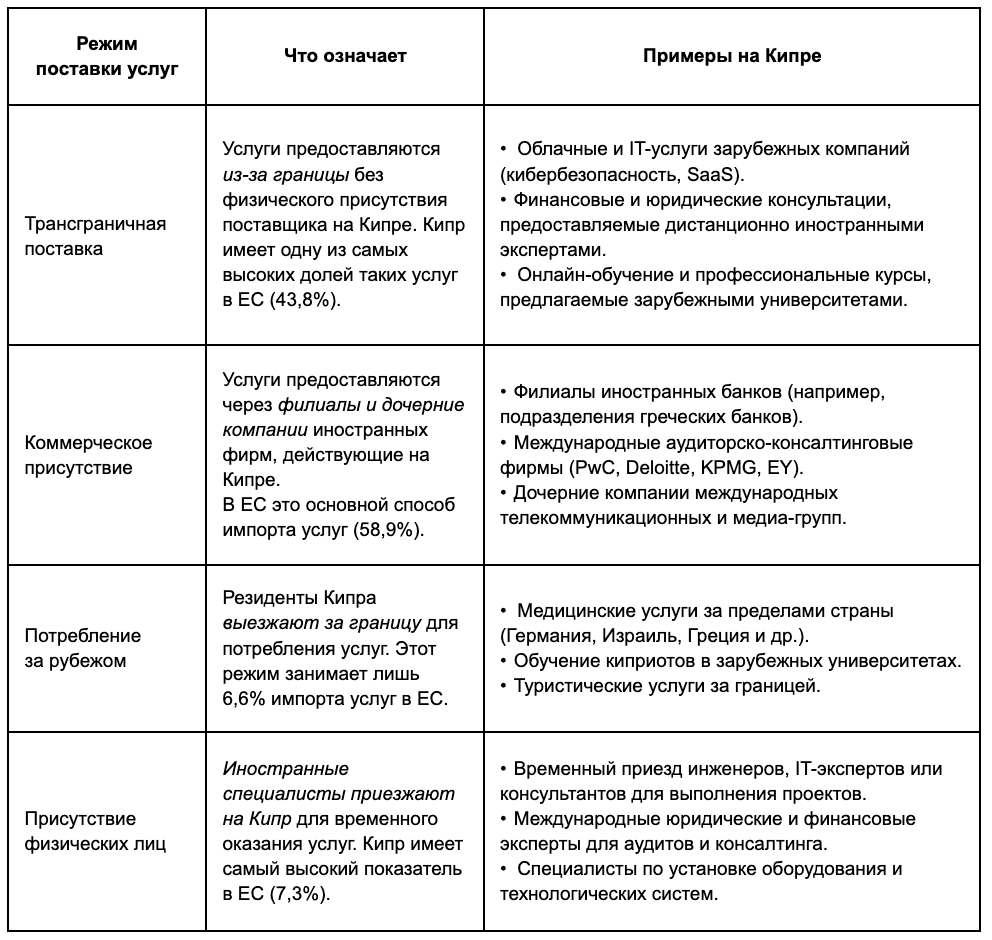
По данным Европейской статистической службы, Кипр занимает второе место среди государств-членов по трансграничным поставкам услуг с показателем 43,8%, уступая лишь Греции (68,8%). На третьем месте находится Швеция (37,7%), а за ней следует Дания (37,4%).
По данным Евростата, в 2024 году государства-члены ЕС импортировали из стран, не входящих в ЕС услуг на сумму 3,471 трлн евро.
Основная их часть (58,9%, или 2,044 трлн евро) была импортирована через коммерческие представительства внутри страны, то есть через дочерние компании иностранных предприятий. На трансграничное предоставление услуг пришлось 31,3% импорта (1,087 трлн евро), на потребление за рубежом – 6,6% (229 млрд евро), а на присутствие физических лиц – 3,2% (111 млрд евро).
Кипр продолжает уверенно выделяться среди стран Европейского союза по уровню трансграничного импорта услуг. Такое доминирование дистанционных сервисов объясняется сильной ориентацией кипрской экономики на цифровые и профессиональные услуги: остров активно пользуется облачными технологиями, онлайн-консалтингом, а также правовыми и финансовыми инструментами, предоставляемыми из-за рубежа. Эта структура подчёркивает гибкость и цифровую интеграцию кипрского рынка услуг.
Несмотря на высокую распространенность дистанционных услуг, коммерческое присутствие иностранных компаний также остается важным каналом импорта, хотя его роль здесь менее выражена, чем в большинстве европейских стран. В ЕС эта модель занимает почти 59% общего объема импорта услуг, однако на Кипре она не так популярна из-за более диверсифицированной структуры экономики. К этому типу предприятий относятся зарубежные банки, международные аудиторско-консалтинговые сети и филиалы крупных медиа- и телекоммуникационных компаний, которые предоставляют на Кипре свои услуги. Такая модель особенно востребована в сферах, где требуется физическое присутствие поставщика.
Что касается присутствия физических лиц в импорте услуг, то Кипр занимает первое место вместе с Данией с показателем 7,3%, а Бельгия следует за ним с 5,4%. Эта категория услуг обеспечивается через временный приезд иностранных специалистов. Речь идет о консалтинге, технической поддержке, инженерных работах, юридических и финансовых услугах, которые требуют краткосрочного визита экспертов. Этот показатель свидетельствует о высоком уровне интеграции острова в международные профессиональные сети и его зависимости от мобильных специалистов, укрепляющих ключевые отрасли экономики.
Потребление услуг за рубежом остаётся относительно небольшим сегментом для кипрских резидентов, что соответствует общей тенденции в Евросоюзе. Лишь около 6,6% всех импортируемых услуг приходится на случаи, когда граждане или компании выезжают за границу для получения необходимых сервисов. В эту категорию входят медицинские поездки, обучение в иностранных университетах, а также туристические услуги. Несмотря на скромную долю, данный режим сохраняет стабильные позиции, отражая традиционные модели мобильности населения.
Текст подготовлен по материалам Cyprus Business News.
Читайте также:
Парадокс кипрской инфляции: почему цены растут?
Во что инвестируют кипрские компании по управлению активами

Статистика демонстрирует восходящую тенденцию в экономическом развитии страны в 2025 году. Согласно данным Статистической службы Кипра (CyStat), рост наблюдался в ключевых секторах экономики, в том числе в сферах недвижимости и туризма.
CyStat опубликовала бюллетень «Экономические события по месяцам» за период с января по декабрь 2025 года. Бюллетень содержит наиболее важные события для экономики Кипра за этот период, а также сравнительные данные за последние четыре года, по состоянию на 16 февраля 2026 года.
По данным бюллетеня, в 2025 году выросли такие показатели, как объем промышленного производства, общая площадь разрешенных к строительству объектов, количество зарегистрированных автотранспортных средств, индекс потребительских цен, общий объем импорта товаров и количество прибытий туристов.
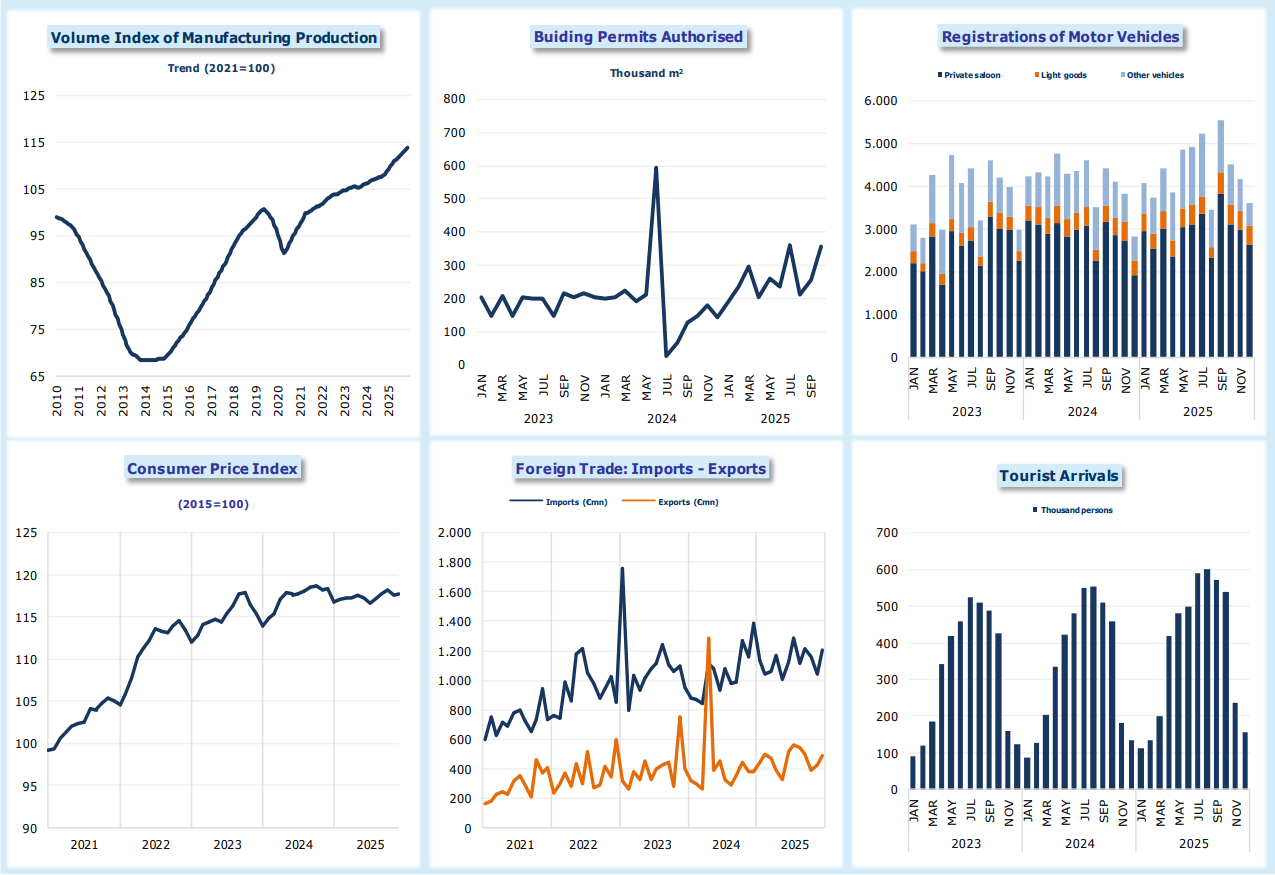
Объем промышленного производства с января по ноябрь 2025 года увеличился на 4,4 % по сравнению с тем же периодом 2024 года.
Общая площадь зданий, получивших разрешение на строительство за период с января по октябрь 2025 года достигла 2 612 тыс. квадратных метров, увеличившись на 30,7 % по сравнению с теми же месяцами 2024 года.
Общее количество зарегистрированных с января по декабрь 2025 года автотранспортных средств увеличилось на 5,8 %, достигнув 52 508. Количество легковых автомобилей составило 35 367 (рост на 3,2 %), а лёгких грузовиков – 4959, что на 6,9 % больше по сравнению с тем же периодом 2024 года.
Индекс потребительских цен за тот же период вырос на 0,1% в годовом исчислении.
Общий объем импорта товаров достиг 13,551 млрд евро за период с января по декабрь 2025 года, увеличившись на 7,7 %, а общий объем экспорта – 5,55 млрд евро, также увеличившись на 7 % в годовом исчислении.
Количество туристов за тот же период составило 4 534 073, по сравнению с 4 040 200 в 2024 году, что означает рост на 12,2 %.
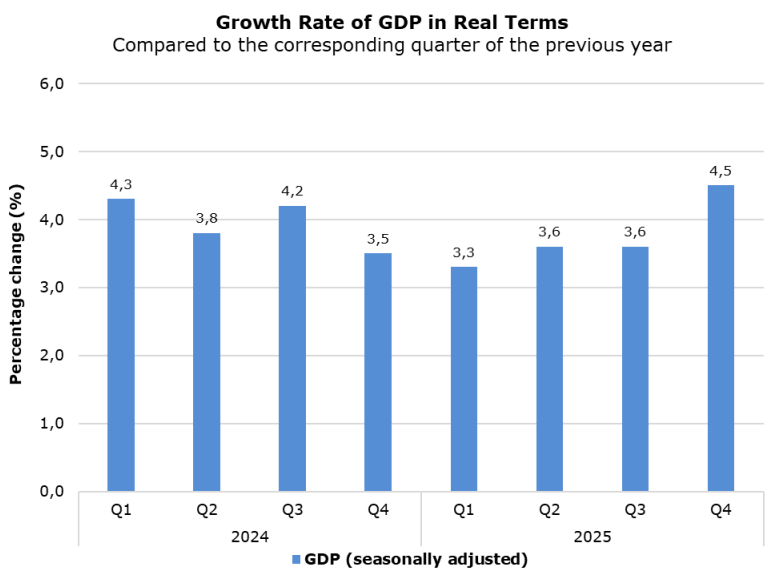
Темп роста ВВП в реальном выражении с учетом сезонных колебаний в четвертом квартале 2025 года, по оценкам, составляет 4,5% по сравнению с соответствующим кварталом 2024 года.
Положительные темпы роста ВВП в основном обусловлены следующими секторами: оптовая и розничная торговля, ремонт автомобилей, информационные и коммуникационные технологии, гостиничный и ресторанный бизнес.
Текст подготовлен по материалам CyStat.
Читайте также:

As economic ties between Cyprus and Kazakhstan intensify, Cypriot companies are looking beyond traditional markets and turning their attention to Eurasia’s most dynamic economy. Costas Markides, President of the Cyprus–Kazakhstan Business Association, explains which sectors hold the strongest potential, why newcomers often misjudge the Kazakh market, and how Cyprus can position itself as a strategic Mediterranean partner. In this interview, he outlines practical steps, policy priorities, and the Association’s long-term vision for deepening bilateral cooperation.
Cyprus-Kazakhstan Business Association gathers companies that are actively exploring the Kazakh market. Based on your experience, which sectors show the fastest-growing interest among Cypriot entrepreneurs?
The fastest-growing interest among Cypriot entrepreneurs in Kazakhstan is concentrated first and foremost in energy (including renewables), financial services, logistics, and technology. These sectors benefit from recent trade missions and conferences, rising investment flows, and strong institutional support, positioning them as the pillars of Cyprus–Kazakhstan economic cooperation going forward.
What are the most common mistakes or unrealistic expectations that Cypriot companies have when approaching Kazakhstan for the first time?
Cypriot companies often stumble in Kazakhstan by expecting EU-style simplicity, overlooking cultural and regulatory realities, and chasing quick wins. Success requires patience, local partnerships, and tailored strategies to the Kazakh market environment.
You work directly with both governments and private sectors. What specific reforms or policy improvements would make business cooperation between Cyprus and Kazakhstan even more dynamic?
To make Cyprus–Kazakhstan business cooperation more dynamic, reforms should focus on reducing bureaucratic barriers, strengthening legal and tax frameworks (promote reforms in double taxation agreements, arbitration mechanisms, and trade finance instruments), enhancing transport connectivity, digitalizing trade processes, and expanding sectoral collaboration. These steps would not only sustain the recent surge in trade and investment but also position both countries as strategic partners in Eurasian commerce.
Looking ahead to the next 3–5 years, what is your vision for the Cyprus–Kazakhstan Business Association? Which flagship projects or initiatives do you hope to launch to strengthen bilateral economic ties?
The Cyprus–Kazakhstan Business Association’s vision for the next 3–5 years should focus on logistics integration, renewable energy, tourism, and financial services, anchored by flagship projects like business summits, digital trade platforms, and joint logistics hubs. These initiatives will transform the Association into a dynamic engine of bilateral cooperation, aligning Cyprus and Kazakhstan with broader EU–Central Asia connectivity strategies.

Over the past few years, relations between Cyprus and Kazakhstan have moved beyond formal diplomacy into a phase of pragmatic engagement. What we are witnessing today is not a coincidence, but the result of parallel interests, economic logic, and a growing mutual understanding between two jurisdictions that see each other as gateways to wider regions.
As someone who has been working closely with both Cypriot and Kazakh business communities, I am increasingly convinced that 2026 can become a turning point in Cyprus–Kazakhstan cooperation, provided that dialogue is translated into structured action.
POLITICAL FOUNDATIONS ARE IN PLACE
At the diplomatic level, the relationship between Cyprus and Kazakhstan has clearly intensified. High-level contacts, regular political dialogue, and the strengthening of bilateral mechanisms indicate that both sides view this partnership as strategically relevant. Cyprus is steadily positioning itself as a reliable EU partner in the Eastern Mediterranean, while Kazakhstan continues to play a key role in Central Asia, combining political stability with an ambitious economic agenda.
For business, this political backdrop is essential. It creates predictability, lowers perceived risk, and signals long-term commitment. Without this foundation, sustainable economic cooperation is impossible.
MOBILITY AND PRACTICAL SIGNALS TO BUSINESS
Equally important are practical decisions that directly affect entrepreneurs. Recent changes in visa arrangements, including the introduction of long-term multiple-entry visas for certain categories of visitors, are a strong signal to the business community. They demonstrate that Kazakhstan understands the needs of international partners who operate across borders and require flexibility, continuity, and ease of movement.
For Cypriot entrepreneurs, this is not a technical detail. It is a message: Kazakhstan is open for long-term cooperation, not one-off visits. We also expect direct flights between our countries: this will give a boost to business contacts and practical agreements between business people of two countries.
WHY CYPRUS AND KAZAKHSTAN ARE COMPLEMENTARY
From my perspective, Cyprus and Kazakhstan are not competitors, but natural complements.
Cyprus offers access to the European Union, well-established legal and corporate structures, experience in fund structuring, international consulting, financial and professional services, and a business culture that understands cross-border operations. Kazakhstan offers scale, resources, industrial capacity, a fast-growing internal market, and a clear focus on export-driven development.
What matters now is to connect these strengths in a systematic way.
BUSINESS-TO-BUSINESS AS THE CORE DRIVER
In my experience, real progress happens not at conferences, but in direct, well-prepared business conversations. This is why I strongly believe in delegation-based formats, targeted meetings, and sector-specific discussions.
In 2026, the SBL Club is planning a dedicated business delegation to Almaty. At the same time, we are preparing to host a Kazakh business delegation in Cyprus. These visits are not symbolic. They are designed to create working relationships, explore joint projects, and identify realistic areas for cooperation, from consulting and finance to manufacturing, logistics, healthcare, and technology.
A STRUCTURED APPROACH IS ESSENTIAL
One of the key challenges I see is the lack of structure in how companies approach new markets. Kazakhstan is not a country where success can be achieved through intuition alone. It requires local understanding, institutional partners, and a clear entry strategy. The same is true for Kazakh companies looking at Cyprus as a base for international expansion.
My role, and the role of the platforms I work with, is to bridge this gap. To translate intentions into action plans. To connect the right people at the right level. And to ensure that cooperation is built on realistic expectations rather than abstract enthusiasm.
LOOKING AHEAD TO 2026
I am cautiously optimistic about the next stage of Cyprus–Kazakhstan relations. The interest is mutual. The political framework exists. Business is ready. What is needed now is leadership, coordination, and trust.
If 2026 is approached thoughtfully, with clear priorities and professional facilitation, Cyprus and Kazakhstan can move from episodic cooperation to long-term partnership. This is not about volume, but about quality. Not about declarations, but about results.
And this is precisely the direction in which I intend to continue working.

For many years, Successful Business has been closely connected to the rhythm of daily media work: news agendas, deadlines, rapid reactions, constant operational pressure. That experience builds discipline, intuition and an exceptional understanding of how business ecosystems function in real time. But 2026 marks a deliberate shift away from constant operational involvement towards a more strategic role. We are focusing on architecture rather than execution, on long-term structures rather than short-term cycles.
This transition is not about slowing down. On the contrary, it is about concentration. About choosing fewer directions and developing them more deeply. About moving from managing information flows to shaping environments where business decisions, partnerships and trust can grow.
At the centre of this strategy is the Successful Business Leaders Club. Over six years, it has evolved as curated professional environment based on personal trust, shared values and long-term thinking. In 2026, the focus is on refining its internal quality: more meaningful collaboration, clearer value for members and stronger mechanisms for joint projects.
The second strategic vector is international. In 2026, particular attention is given to three directions: Armenia, Kazakhstan and Uzbekistan. These are not viewed as export markets or destinations for selling finished products. The emphasis is on co-creation: joint ventures, shared expertise, investment structures, educational and technological initiatives where Cypriot businesses can act as partners rather than suppliers.
Years of working with business owners, officials and professional communities across different countries have shown that real opportunities emerge where there is patience, cultural sensitivity and a clear strategic framework.
Psychologically, this shift also responds to a growing demand among business leaders themselves. Many are tired of fragmented activities and constant tactical noise. They are looking for environments where conversations are confidential, and where strategy is developed calmly and professionally. The projects planned for 2026 are designed precisely with this mindset in mind.
Successful Business remains a media platform, but increasingly it is also becoming a space for reflection, expertise and strategic dialogue. Sustainable business is built not by those who run faster every day, but by those who know when to step back and design the next stage thoughtfully.
Natalia Kardash

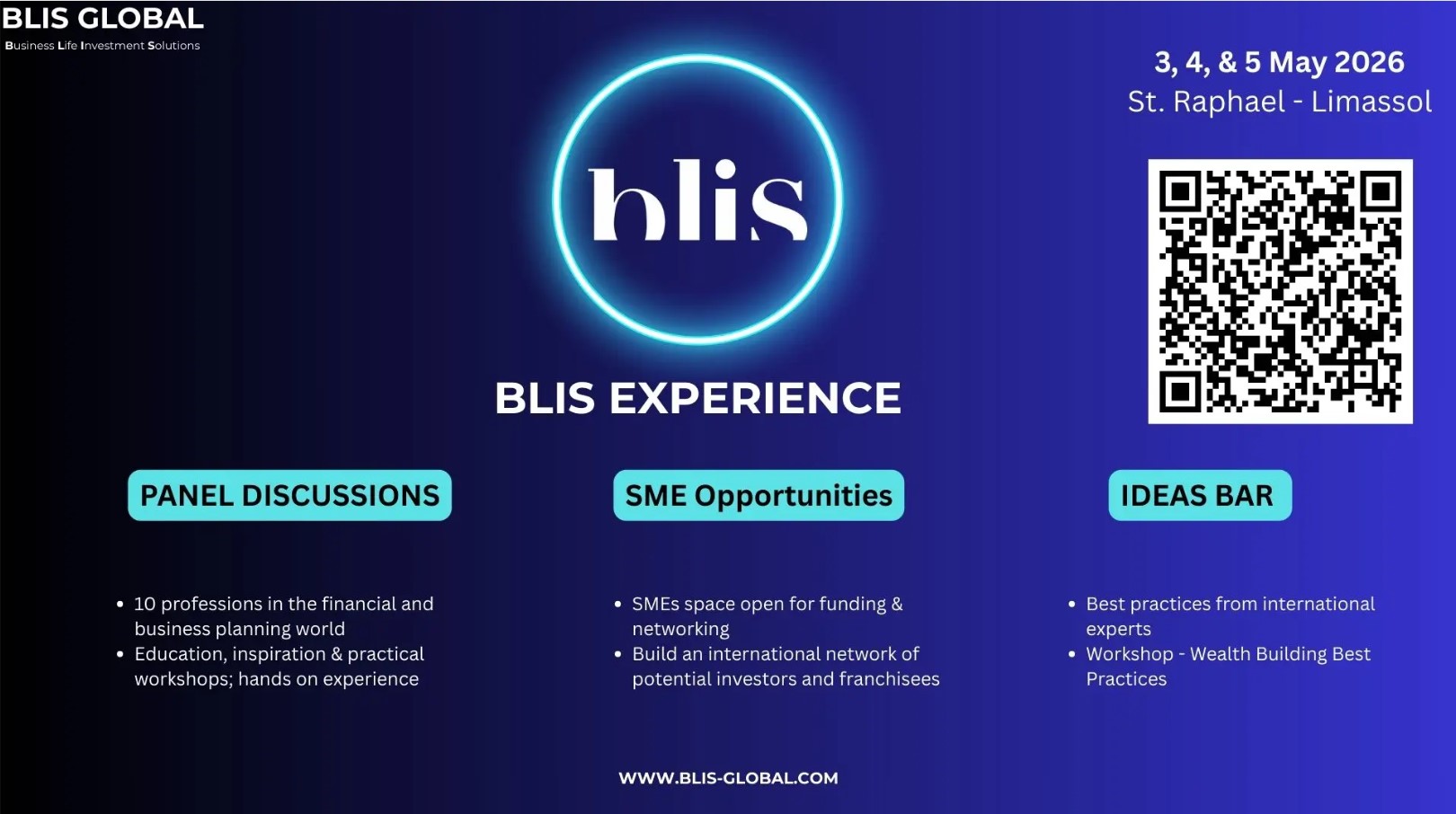
BLIS Global Experience – это трёхдневное международное мероприятие, направленное на развитие профессионального диалога, обмен опытом и повышение стандартов работы в ключевых сегментах финансового и бизнес-планирования. Форум пройдёт с 3 по 5 мая 2026 года в отеле St. Raphael Resort в Лимассоле.
Мероприятие объединяет руководителей, ведущих экспертов, лиц, принимающих решения и международных специалистов. Будет представлено десять профессиональных направлений: юридические и корпоративные услуги; бухгалтерия, аудит и налогообложение; инвестиции и управление капиталом; страхование; финтех и технологии; банковский и финансовый сектор; консалтинг и обучение; сертификационные организации, а также рынок недвижимости. Программа включает панельные дискуссии, практические сессии, прикладные воркшопы и возможности для профессионального нетворкинга.
Программа мероприятия
Программа форума рассчитана на три дня и сочетает стратегические обзоры с практическими инструментами, применимыми как на личном, так и на корпоративном уровне.
День 1 – воскресенье, 3 мая 2026 года (начало в 16:00)
16:00 – Воскресенье – не просто день недели – стратегическая сессия с Кеньоном Сало.
16:40–17:00 – Наджи А. Хаддад и Джейд У. Дагер: почему BLIS Global – это не просто мероприятие, а сообщество и профессиональная экосистема.
17:00–18:30 – Почему финансовое планирование – не роскошь, а необходимый инструмент для формирования наследия.
Панельная дискуссия с участием ведущих экспертов из представленных профессиональных сфер.
18:30 – Сессия вопросов и ответов.
День 2 – понедельник, 4 мая 2026 года
10:00 – Сессия 1: Диверсификация источников дохода
1. Зачем необходима диверсификация.
2. Куда целесообразно диверсифицировать.
3. Когда диверсификация становится избыточной и усложняет управление.
12:00 – Сессия 2: Управление денежными потоками на личном и бизнес-уровне
1. Разница между отчётом о прибылях и убытках и отчётом о движении денежных средств.
2. Как сократить расходы без ущерба для уровня жизни и рыночного позиционирования бизнеса.
3. Снижение проблемной задолженности при сохранении положительной кредитной истории.
14:30 – Сессия 3: Защита доходов и денежных потоков от прямых, косвенных и скрытых угроз
1. Работа в условиях инфляции и кризисов.
2. Управление прямой и косвенной конкуренцией в бизнесе.
3. Защита доходов от непредвиденных рисков: смерти, инвалидности и критических заболеваний.
16:00 – Сессия 4: Действительно ли сбережения работают на вас?
1. Краткосрочные сбережения: зачем они нужны, в каком объёме и где их безопасно размещать.
2. Среднесрочные сбережения как инструмент достижения более масштабных целей.
3. Долгосрочное планирование: продолжительность жизни растёт — готовы ли вы к этому?
День 3 – вторник, 5 мая 2026 года
10:00 – Сессия 5: Куда инвестировать в современном мире?
1. Акции, облигации, фонды и финансовые решения: практическая дорожная карта выхода на рынок среднего сегмента.
2. Инвестиции в недвижимость через инновационные инструменты и модели.
3. Бизнес-возможности вокруг нас: как своевременно их выявлять и использовать.
12:00 – Сессия 6: Финансовая свобода – не для всех, а для тех, у кого есть видение, план и дисциплина
1. Что такое финансовая свобода и насколько вы близки к её достижению.
2. Формирование наследия: корректное планирование преемственности и управления активами.
3. Практический кейс по планированию преемственности на примере трёх поколений.
14:30 – Сессия 7: Почему Кипр – и почему именно сейчас
1. Стратегическое расположение и ключевые преимущества юрисдикции.
2. Стратегические партнёрства и соглашения об избежании двойного налогообложения.
3. Успешные кейсы представителей разных национальностей.
16:00 – Сессия 8: VIP-чеклист для устойчивости и конкурентного преимущества
1. Защита данных, кибербезопасность и скрытые риски.
2. Интеграция технологий и искусственного интеллекта для более эффективного планирования.
3. Эпоха специализации и профессиональной сертификации как способ повышения стандартов и защиты клиентов от псевдоэкспертов.
Дополнительные форматы
Помимо основной программы, участников ожидают выставочные зоны, Ideas Bar со специальными приглашёнными спикерами, а также практические воркшопы, включая сессию Wealth Building Best Practices, проводимую лидерами отрасли.
Регистрация
Участникам доступны стандартные билеты и расширенные пакеты, включающие гала-ужины и полный доступ ко всем сессиям. Количество мест ограничено, организаторы рекомендуют раннюю регистрацию.
Подробная информация и регистрация.
Материалы предоставлены BLIS Global Experience.

As Cyprus strengthens its diplomatic and economic engagement with Central Asia, Kazakhstan has emerged as a key strategic partner in the region. With both countries expanding their diplomatic presence and exploring new avenues for cooperation, opportunities are opening up across investment, connectivity, logistics, digitalisation, and tourism. In this interview, His Excellency Petros Nacouzis, Ambassador of Cyprus to the Republic of Kazakhstan, shares his perspective on the strategic importance of Kazakhstan for Cyprus, the practical support available to Cypriot businesses entering the Kazakh market, and the priorities for advancing bilateral and EU–Kazakhstan cooperation in the years ahead.
Cyprus has recently strengthened its presence in Central Asia. From your perspective, what strategic advantages does Kazakhstan offer to Cyprus within the region’s political and economic landscape?
The establishment of our diplomatic mission in Astana a little more than a year ago, will undoubtedly strengthen our presence in this part of the world. Additionally, the opening by Kazakhstan of an Embassy in Nicosia will further advance our bilateral relations and serve our common interests more efficiently.
Kazakhstan occupies a pivotal position in Central Asia, both geographically and strategically, serving as a bridge between Europe and Asia. From Cyprus’s perspective, Kazakhstan offers a stable political environment, a forward-looking economic agenda and a clear commitment to regional connectivity. Its role as a leading economy in Central Asia, combined with its active diplomacy and engagement with international partners, makes it an important interlocutor for Cyprus in the region.
Kazakhstan’s openness to foreign investment, its emphasis on diversification beyond hydrocarbons, and its growing sectors such as logistics, renewable energy, digital technologies and education, create concrete opportunities for mutually beneficial cooperation. Moreover, Cyprus’s position as an EU Member State allows us to serve as a gateway for Kazakhstan to European markets, regulatory frameworks, and business networks, while Kazakhstan offers Cyprus a valuable entry point into Central Asia.
Cyprus' investments in Kazakhstan since the establishment of diplomatic relations (FDI) have reached €4 billion and 326 companies with Cypriot participation are active in the country.
Beyond economics, we value Kazakhstan’s constructive role in regional stability, multilateral dialogue, and international diplomacy. These shared interests provide a strong foundation for deepening bilateral relations and for Cyprus’s broader engagement with Central Asia.
As more Cypriot companies explore Kazakhstan, what practical support can your Embassy provide to help them navigate regulatory frameworks, culture, and local business norms?
Supporting Cypriot businesses entering the Kazakh market will be a key priority for our Embassy. We will provide practical assistance by offering initial briefings on Kazakhstan’s legal and regulatory environment, investment rules and sector-specific requirements, in close cooperation with relevant Kazakh authorities and institutions.
The Embassy will facilitate the introduction to reliable local partners, business associations and public bodies, helping Cypriot companies build the right networks from the outset. We also intend to work closely with Kazakh investment and trade promotion agencies to identify opportunities and clarify procedures, while guiding companies toward reputable legal, financial, and consulting services when specialized expertise is required.
Through business forums, targeted meetings, and high-level visits, platforms are created where Cypriot and Kazakh businesses can interact directly.
Our role is to act as a trusted bridge, reducing uncertainty, facilitating dialogue and ensuring that Cypriot companies can approach the Kazakh market with confidence and a clear understanding of both the opportunities and the local context.
Kazakhstan positions itself as a major connectivity hub between Europe and Asia. How can Cyprus leverage this to deepen cooperation in areas such as logistics, shipping, aviation, or digital corridors?
Kazakhstan’s role as a key connectivity hub between Europe and Asia aligns naturally with Cyprus’s own strengths, given its strategic location in the Eastern Mediterranean among three continents. Cyprus sees strong potential in linking our complementary positions—Kazakhstan as a continental transit and logistics hub and Cyprus as a maritime, aviation, and services gateway to the European Union and the Mediterranean.
In logistics and shipping, Cyprus can contribute its long-standing expertise in maritime services, port management, and ship registration, while exploring cooperation with Kazakhstan on multimodal transport corridors that connect Central Asia with European and Mediterranean markets. In aviation, there is scope to enhance connectivity through partnerships between airlines, cargo services, and civil aviation authorities, facilitating passenger flows, tourism, and high-value freight.
Digital connectivity is another promising area. Cyprus supports initiatives that strengthen digital corridors, data services, and fintech cooperation, drawing on EU standards and regulatory frameworks, which can complement Kazakhstan’s ambitions to become a regional digital hub.
Cyprus brings decades of valuable experience as a leading Mediterranean tourism destination, having successfully developed a diversified, high-quality tourism model that balances growth with sustainability. This expertise can be meaningfully shared with Kazakhstan, a country which has a rich natural and cultural heritage, and which has demonstrated a strong interest in further developing its tourism sector. There is significant potential for cooperation through the exchange of best practices in destination management, sustainable and year-round tourism, digital promotion, and human-capital development.
Looking ahead to Cyprus’s EU Presidency in 2026, which specific initiatives or agreements with Kazakhstan would you personally like to see prioritised and advanced?
As Cyprus prepares to assume the Presidency of the Council of the European Union in January 2026, we see a valuable opportunity to further elevate relations between the European Union and Kazakhstan, with Cyprus playing a constructive role.
Kazakhstan and the European Union held the first round of official negotiations this month, on concluding a Visa Facilitation Agreement and a Readmission Agreement between the two and I hope to see the conclusion of these Agreements during our EU presidency.
During Cyprus’s EU Presidency, we would encourage initiatives that strengthen EU–Kazakhstan engagement in connectivity, digitalisation, energy transition and sustainable transport, building on existing EU–Central Asia frameworks. Cyprus can contribute its experience as an EU Member State and a regional hub, helping to align bilateral cooperation with broader European priorities.
At the bilateral level, one immediate and tangible priority is the launch of direct flights between Cyprus and Kazakhstan supported by our embassy (issuing of visas), hoping to start next summer, which will significantly enhance people-to-people contacts, tourism, and business.
Alongside improved connectivity, I would like to see the timely conclusion and implementation of several pending bilateral agreements and Memorandums of Understanding, as these instruments provide the practical framework that allows cooperation to move from intention to concrete results.
Petros T. Nacouzis is a career diplomat and the first resident Ambassador of the Republic of Cyprus to the Republic of Kazakhstan, having presented his credentials in January 2025. He holds a Law degree from the University of Thessaloniki and an LLM in International Law from the University of Hull (UK). Before joining the Cyprus Foreign Service in 1993, he practiced law in Cyprus. His diplomatic career includes postings in Rome, Damascus, and Moscow, as well as senior roles at the Ministry of Foreign Affairs in Nicosia, with a focus on political, consular, and regional affairs. Before his appointment as Ambassador of the Republic of Cyprus to Kazakhstan, he served from 2021 to 2024 as Ambassador of Cyprus to Poland, with concurrent accreditation to Lithuania.

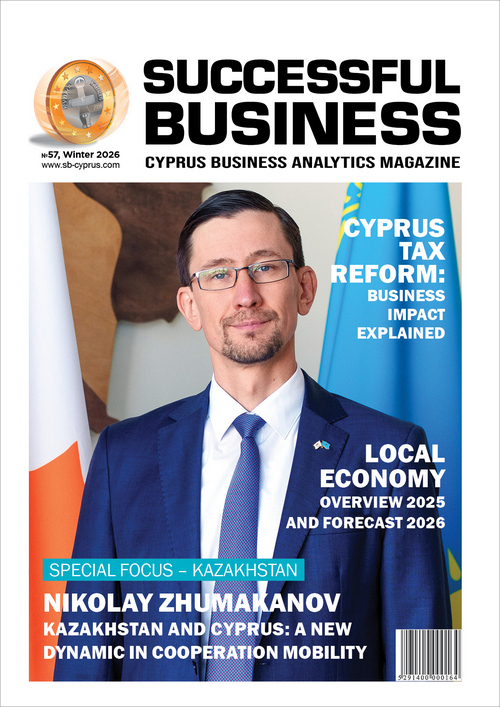
In 2025, Kazakhstan opened its embassy in Cyprus, thereby elevating bilateral relations to an entirely new level. Today, an active political dialogue is developing between the two countries, business cooperation is being strengthened, investment initiatives are taking shape, and the introduction of direct air connectivity is expected. In this interview, the Ambassador of Kazakhstan to the Republic of Cyprus, Nikolay Zhumakanov, explains how foreign investors are protected in Kazakhstan, which Kazakh sectors are the most promising for Cypriot business, what makes the Middle Corridor unique, and why new opportunities for cooperation are now emerging between Astana and Nicosia, and between the private sectors in Kazakhstan and Cyprus.
– Your Excellency, how would you assess the current state of economic relations between Cyprus and Kazakhstan?
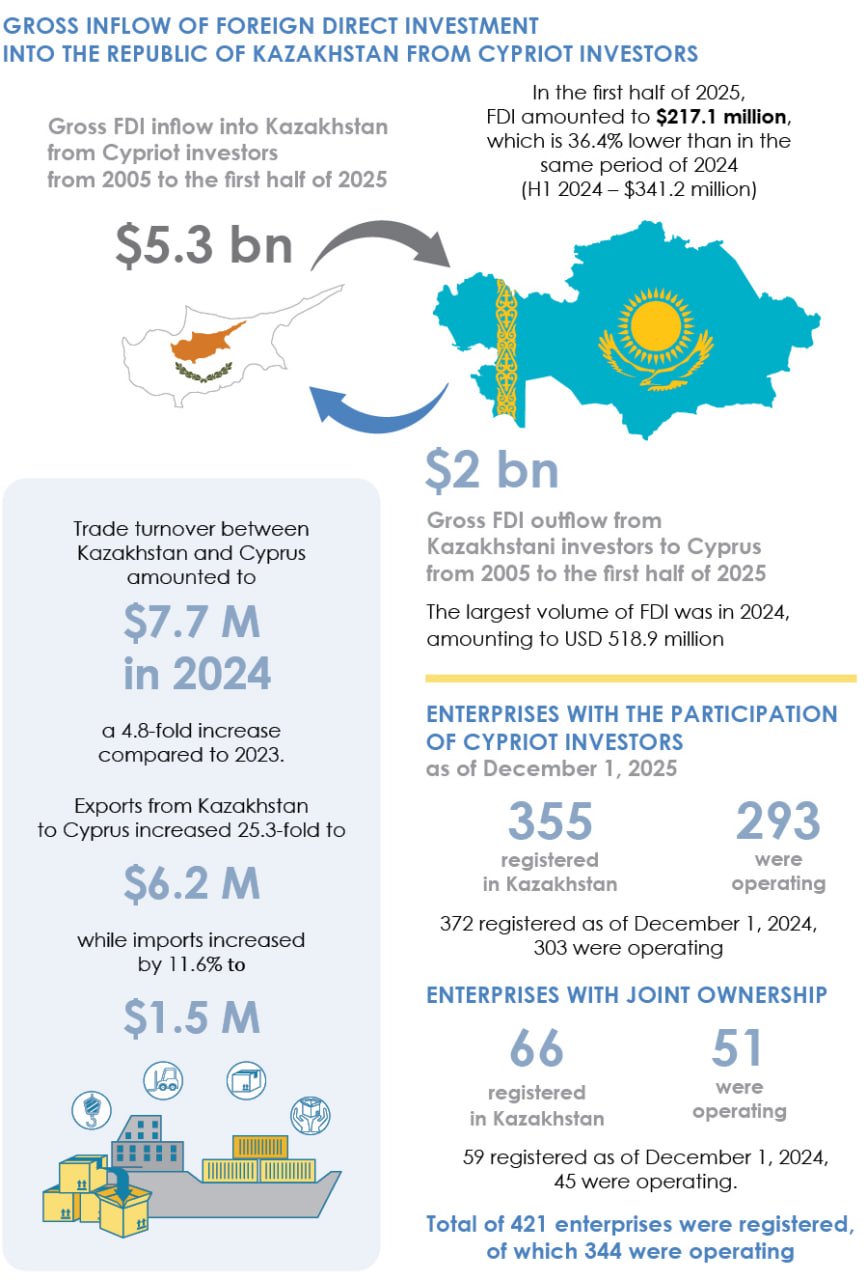
– Trade turnover between our countries is currently modest, unstable, and varies from year to year. In certain years, there are one-off deliveries involving significant amounts, but overall trade volumes remain below one million US dollars (USD 625,000). It is therefore difficult to speak of well-developed trade relations at this stage, although clear prospects are evident.
The situation in the investment sphere is quite different. According to statistics since 2005, the total volume of Cypriot investments in Kazakhstan amounts to USD 5.3 billion, while Kazakh investments in Cyprus are approximately USD 2.0 billion. These are substantial figures that reflect the scale of economic interaction. At the same time, Cyprus often acts as an international business hub, with many investments channelled through Cypriot companies that use the island as a convenient jurisdiction for capital structuring.
– Which sectors does Kazakhstan consider the most promising for investors, including Cypriot ones?
– Today, Kazakhstan is interested in attracting investment across virtually all sectors of the economy. We see particular potential in the production of high value-added goods, IT, the financial sector, tourism, transport and logistics solutions, and agriculture.
Infrastructure development is currently progressing actively in Kazakhstan. This includes dry ports on the border with China, new railway crossings, port complexes on the Caspian Sea, and motorways. Of particular importance in this context is the development of the Trans-Caspian International Transport Route, which is taking shape as a key corridor linking China, Central Asia, the Caucasus, and Europe.
Agriculture represents a major standalone sector. The diversity of climatic zones allows for the development of both crop production and livestock farming. Kazakhstan is attractive not only because of its domestic market of 20 million people, but also due to access to significantly larger markets – Russia, Uzbekistan, Kyrgyzstan, and China – including through unified customs and trade regimes within the Eurasian space.
 – How are the interests of foreign investors protected in Kazakhstan? What mechanisms are in place to minimise their risks?
– Kazakhstan has established a comprehensive system for the protection of investors. Its foundation is the Entrepreneurial Code. At present, a draft Agreement on the Mutual Protection of Investments between Cyprus and Kazakhstan is at the approval stage, while a Convention on the Avoidance of Double Taxation is in force.
For large-scale projects, individual investment agreements are signed. If the volume of investment exceeds USD 60 million, the agreement is signed on behalf of the Government, and the state becomes a direct guarantor, ensuring the stability of conditions and commitments. For investments of a smaller scale, there is also a graduated system of incentives.
In addition, a number of specialised institutions operate in Kazakhstan:
– Kazakh Invest acts as a one-stop shop, serving as a single point of entry and contact, and accompanies projects from the initial stage through to the signing of contracts.
– The Foreign Investors’ Council under the President serves as a platform for major strategic projects.
– The Council for Attracting Investors (Investment Headquarters), chaired by the Prime Minister of the Republic of Kazakhstan, together with relevant structures at the ministerial level, provides tailored support for strategic and priority investment projects.
– A new Committee for the Protection of Investors’ Rights under the General Prosecutor’s Office, recently established by presidential instruction, considers disputes or misunderstandings should they arise.
Thus, Kazakhstan has developed a comprehensive system for the protection of investors. It is of fundamental importance to us that investors trust Kazakhstan and have no doubt about the state’s readiness to provide support at all stages of project implementation.
– If we speak about the economic potential of cooperation between the two countries, in which areas do you see the greatest growth?
– Much depends on logistics. With the formation of sustainable transport chains, trade turnover will be able to demonstrate steady growth. In this context, the launch of direct air connectivity, as well as the development of maritime transport schemes, could play a significant role.
At the same time, it is important to take into account the scale of the markets. For Kazakhstan, Cyprus represents a relatively small market, whereas for Cyprus, Kazakhstan, by contrast, is a large and capacious market. Cypriot companies do not always objectively possess production volumes sufficient to simultaneously meet the needs of the domestic market and those of Kazakhstan, with its population of around 20 million people.
At the same time, statistics on investment presence indicate a stable interest on the part of Cypriot business in Kazakhstan. As of 1 December 2025, 421 enterprises with the participation of Cypriot investors were registered in Kazakhstan, of which 344 continue their operational activities. This confirms the long-term and practice-oriented nature of economic cooperation.
Exports of certain Cypriot goods to Kazakhstan, or supplies of Kazakh products to Cyprus, are possible, but are likely to remain niche due to transport costs and production volumes in both countries. For Cypriot business, Kazakhstan may be of interest primarily as a gateway to a vast regional market.
Overall, we are ready to work with companies from all sectors. It is important to present Kazakhstan to them, give them the opportunity to assess its potential, and allow them to choose the most appropriate direction for their activities. The country offers favourable conditions and a transparent organisation of business processes, including the digitalisation of public services, the banking sector, company registration, and reporting.
– One of the key areas of development in the region is the Middle Corridor, also known as the Trans-Caspian route. What are its main features and what makes it unique?
– In essence, the Middle Corridor represents a modern analogue of the Great Silk Road. Historically, this route connected East and West, and today it is once again emerging as one of the most promising transport and logistics corridors. Its key advantage lies in the speed of cargo delivery. While maritime routes from China or Kazakhstan to European Union countries typically take 30–40 days on average, transit via the Middle Corridor takes approximately 10–12 days, even taking into account transshipment across the Caspian and Black Seas.
Over the past 15 years, Kazakhstan has invested substantial resources – around USD 35 billion – in the development of the corridor’s infrastructure, including the construction and modernisation of railways and roads, as well as port infrastructure. This includes the ports of Aktau and Kuryk on the Caspian Sea and a network of dry ports. Until recently, the Middle Corridor was viewed primarily as an alternative route; however, over the past five years, cargo volumes transported along this channel have demonstrated multiple-fold annual growth. As a result, the route has taken shape as one of the key logistics arteries of the region.
– Kazakhstan opened its embassy in Cyprus, stating that this step corresponded to its national interests. Cyprus is a friendly country, and the deepening of bilateral relations is entirely natural. How do you assess the situation and prospects now, one year after the opening of the embassy?
– Kazakhstan pursues a multi-vector foreign policy and seeks to maintain respectful relations with all countries. We enjoy good relations with Russia, China, the states of Central Asia, the European Union, the United States, Turkey, and many other partners.
Kazakhstan and Cyprus share many points of convergence on the international stage. Both countries are active within the framework of the United Nations, often support each other in elections to its bodies, and hold similar positions on key international issues. Last year, the Deputy Prime Minister – Minister of Foreign Affairs of the Republic of Kazakhstan paid an official visit to Cyprus. This visit was the first in the history of bilateral relations and marked an important milestone in the development of political dialogue between our two countries.
Cyprus is a valuable partner within the European Union. Its position and unique understanding of the region are particularly important in light of Cyprus’s current Presidency of the Council of the EU. In turn, Kazakhstan is a member of organisations to which Cyprus does not have direct access, such as the CIS (Commonwealth of Independent States), the SCO (Shanghai Cooperation Organisation), and the Organisation of Turkic States. This creates new channels for dialogue and cooperation.
 – What outcomes does Kazakhstan expect from Cyprus’ Presidency of the Council of the European Union?
– We regard this Presidency as an important opportunity to advance a number of priority initiatives. First and foremost, this concerns the agreement on visa facilitation between Kazakhstan and the European Union. Negotiations are already under way, and we hope that during Cyprus’ Presidency it will be possible to accelerate and, potentially, conclude this process. Visa facilitation would significantly strengthen business ties and people-to-people exchanges.
In addition, we expect further development of cooperation between the EU and Central Asia in the fields of economy, transport, energy, and digitalisation. Cyprus’ Presidency may give fresh momentum to these areas.
– How would you assess Kazakhstan’s relations with the European Union overall?
– Kazakhstan’s relations with the European Union are characterised by stability and substance. The EU remains Kazakhstan’s largest trading partner and the main source of foreign direct investment. In 2024, bilateral trade turnover exceeded USD 49 billion, while the gross inflow of foreign direct investment from EU countries since 2005 has amounted to approximately USD 200.7 billion, which represents around 48% of total FDI inflows.
The Enhanced Partnership and Cooperation Agreement, signed in December 2015, became the first legal instrument of its kind between the EU and a partner in Central Asia. It provides for cooperation across 29 key policy areas, including trade, investment, transport, energy, environment, education, and many others.
We continue to expand this cooperation – from trade and energy to sustainable development and the improvement of the business environment.
– The possibility of introducing direct flights between Kazakhstan and Cyprus is being discussed. At what stage is this issue now?
– The prospects are very encouraging. Both sides are showing strong interest. At present, passengers are required to travel with transfers; however, even under these conditions, the Embassy of Cyprus in Astana issues between 100 and 200 visas per month to Kazakh citizens. This clearly indicates genuine demand.
Direct flights would significantly simplify travel, increase tourist flows, and be beneficial for business. Kazakhstan, with a population of 20 million and a sustained interest in beach holidays, could become a new source of tourists for Cyprus. At the same time, Cypriot travellers would be able to discover Kazakhstan both as a summer and a winter destination.
– What tourism opportunities can Kazakhstan offer to travellers from Cyprus?
– Tourists have access to a wide range of attractions. In particular, there are ski resorts, including Shymbulak, located near Almaty and regarded as one of the leading ski resorts in the region. During the summer season, there are numerous hiking routes, mountain lakes, and natural landmarks, including Charyn Canyon and Lakes Kolsai and Kaindy.
Northern Kazakhstan is known for the Burabay resort area, with its forests and lakes. The eastern part of the country is characterised by picturesque mountain and taiga landscapes, while western Kazakhstan stands out for the unique scenery of Mangystau, including the Ustyurt Plateau and the Bozzhyra tract, renowned for its chalk formations and striking natural relief.
Alongside its natural attractions, Kazakhstan also boasts a rich cultural and historical heritage. A special place is occupied by Turkestan, home to the Mausoleum of Khoja Ahmed Yasawi, a UNESCO World Heritage Site, as well as other ancient cities and monuments of the Great Silk Road.
Those interested in contemporary architecture and urban development will find the capital, Astana, particularly appealing, with its futuristic appearance and bold architectural solutions.
We intend to actively promote tourist routes, develop cooperation with tour operators, and organise familiarisation trips for Cypriot agencies.
Interview by Natalia Kardash
Nikolay Zhumakanov is a career diplomat, he has extensive experience in international law, European affairs, and multilateral diplomacy.
Over the years, he has served in senior roles at the Ministry of Foreign Affairs of Kazakhstan, including as Director of the International Law Department, and has worked at the Embassy of Kazakhstan in Belgium, closely engaging with EU institutions. His professional background combines public service and corporate governance, providing a strong foundation for advancing Kazakhstan–Cyprus political, legal, and economic cooperation. Since January 2025, he has been Ambassador Extraordinary and Plenipotentiary of Kazakhstan to Cyprus.