

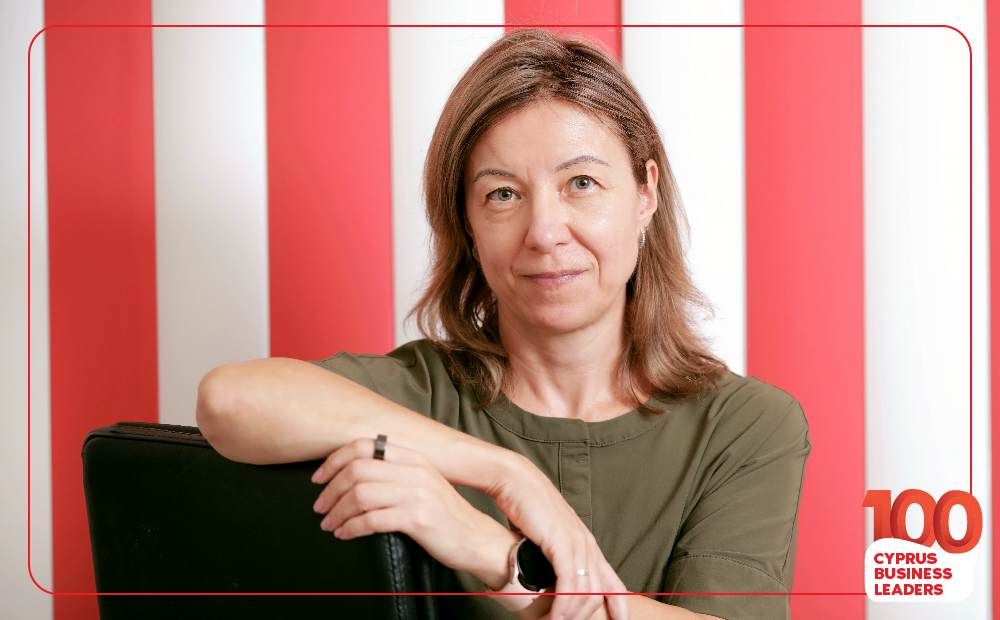
Katya Dolgova is the Co Founder and Chief Operating Officer of Redhill Games and the Founder of the HR consultancy It Starts With You. Her career spans work as a lawyer, more than two decades in HR, leadership roles in international corporations and the launch of her own ventures. Today, she combines the roles of strategist and mentor – building processes, guiding teams and helping companies grow, drawing on her deep understanding of people.
You hold degrees in linguistics and law, started your career as a lawyer and later moved into HR and management. How do you explain this professional shift – what felt natural about it, and what required courage?
In Russia at the time I started my career, many people found their way into HR from neighbouring fields – law, teaching or psychology. There were hardly any dedicated HR management programmes, so like me, many arrived there “sideways”.
I started out as a civil and labour lawyer and even in that role brushed up against people related issues – mostly through documents and court cases. The turning point came during the 1998 crisis when I was working with a Western company that had no formal HR function, only recruitment. Suddenly, there was a pressing need to manage mass redundancies – and I was asked to take it on.
That became my first real HR project. As I immersed myself further, I discovered HR was not just about hiring and firing – it was about development, about helping people build careers, about support. The move felt completely organic and in line with my values, even if on paper it looked like a significant career change.
You have worked with people and projects across different countries and cultures. What key lessons on leadership and teamwork have you taken from that experience?
My first lesson was deeply personal: I realised I never wanted to work again in organisations with the old Soviet style approach – everything built on control and pressure. That kind of culture crushes initiative and creativity.
Over time, I learned that every company is, in many ways, a reflection of its founders and leaders. Their values, their sense of right and wrong – it all filters through into management style, decision making and the everyday atmosphere.
And another crucial insight: a leader must be able to listen and truly hear. It’s a rare skill. Many people can talk – very few can listen. I am convinced that this quality is what sets great leaders apart.
How has your understanding of leadership evolved over the years? And what qualities must a leader have to stay effective in today’s fast changing world?
When you start your career, your experience is limited to school, university and your first job. I began in a post Soviet bank, where the rule was simple: if the boss said it, that was the end of the discussion.
Later, in an international company, I saw for the first time that you could challenge, question, suggest different solutions. At first, it felt strange – how could you argue with a manager who has given you a task? – but that’s when I realised: sometimes you’re given a task precisely because you have expertise they don’t.
Another major transformation was learning to delegate. Like many perfectionists, I believed I could do everything better by myself. But over time I understood that trust and the ability to step back are essential – they allow your team to grow and your business to develop.
Every career has moments of crisis and growth. Was there a point that fundamentally changed how you see your work or yourself?
There were two moments of this kind. The first was when my family and I decided to leave Russia and see what it would be like not just to visit another country, but to live and work there. I went from being the head of HR for a large region of branches to a part of a “bigger system”, just one professional among many. It was a cultural and professional shift – and I had to learn how to position myself in an entirely new environment.
The second was the decision to leave corporate life and start my own ventures. That required courage: there is no monthly salary, no safety net, only full responsibility. And when you’re not a solo 25 year old start upper but someone with a family and children, you need not just your own bravery – you need the support of those closest to you.
Your work involves managing teams and developing new directions. What helps you bring people together around a shared goal and keep them motivated?
It all begins with clarity of purpose. If the leadership team knows where they are going, that vision can be shared with everyone else. One of our golden rules has always been to have maximum transparency. Everything that can be communicated – is communicated: from long term goals to current challenges and the obstacles we might face.
That openness creates a sense of involvement. People feel they’re shaping the process, not just ticking off tasks. And then there’s the individual approach – some need more feedback, some thrive with greater independence. But the foundation is always the same: openness and respect.
When you face uncertainty, what do you rely on first – experience, data, intuition or your own principles?
When we make decisions collectively, everyone brings their own experience, data, contacts, context – and together we find a solution we can all stand behind.
When I have to decide alone, and the information is scarce – that’s never pleasant. In those moments, I fall back on a mix of experience and intuition. And intuition doesn’t just come from nowhere – it’s built on everything you’ve seen, learned and lived through.
One more rule I try to follow: a bad decision is better than no decision. A bad decision can be revised when new facts come in. But if you don’t decide at all – you paralyse the process and the people depending on you.
 Your career spans law, HR, creativity and business leadership. How does this broad experience shape the way you make decisions?
I always start by gathering as much information as possible and weighing up the pros and cons. My legal training helps: I automatically think through the worst case scenarios. What’s the potential downside? How can we minimise the risks?
That doesn’t mean I focus only on the negative – it’s more about balance. Sometimes you have to choose the lesser of two evils. Sometimes you need to take a risk. But I never “flip a coin” – even improvisation is grounded in research.
In moments of doubt or inner tension, what helps you regain balance and keep moving forward?
I’ve learned that short but high quality breaks work best for me. I don’t always need a long holiday – sometimes a long weekend is enough to reset and keep going. It’s important for me to physically change my surroundings, to step away from the daily routine – that could be a quick trip or simply a few days of quiet at home, without calls or meetings.
Reading also plays a huge role. I’ve been a reader since childhood, and for me it’s more than a hobby – it’s a way to switch off. A good book – whether it’s a novel, a biography or something completely unrelated to work – can turn off the “work loop” in my head. Sometimes it’s even more powerful than rest because it allows me to look at familiar challenges from a new angle.
What qualities do you particularly value in the people you work with? And what qualities have helped you grow as a leader?
If there is an expression I often reach for to describe a combination of features, its English equivalent would be level headedness.
Sounds simplistic, but for me it includes many qualities: the ability of a person to react to their circumstances with honesty, discuss problems directly and reach consensus on issues. If there is a problem - it's important to raise it. If a task cannot be completed, it's important to be transparent about it. This aids in saving both time and energy, helping to solve rather than hide problems.
I value people who keep their word. Reliability isn’t just a formal trait – it’s the basis of trust. And without trust, you can’t build teams or projects.
As for me – from an early age I felt I had to rely primarily on myself. That built resilience, but with time I learned that no one can carry everything alone. I had to learn to delegate, to trust, to accept help – and that made me stronger as a leader.
If you had to describe your main inner driver in one word, what would it be?
One word isn’t enough – there are three.
First is responsibility. It covers everything: family, colleagues, the company, projects, the industry I work in, even the country I live in. It’s the feeling that I can’t just “step aside” and say it’s not my concern.
Second is the desire to help. It probably flows from responsibility. If I have knowledge, contacts, experience, time – I should use them to make something better, whether that’s a colleague’s work, the life of a team or the wider context.
And third is the satisfaction of achieving a goal. That special moment when I can mentally pat myself on the shoulder and say, “I did it.” And if the process was just as interesting as the outcome – that’s double the reward.
Cyprus has marked a new chapter in your life and work. What, in your view, makes this island special for business and personal growth?
When I first arrived, Cyprus was primarily a tourist island with a small business community centred in Limassol. Today, it’s a different story: every major city has its own clusters, its own networks, its own energy.
The companies that relocated here from around the world played a big part. They brought new expectations – about services, infrastructure, speed – and that pushed the island to evolve. It’s now easier to build a career or start a project here than it was 10 or 15 years ago.
Cyprus is also unique because it combines a professional environment with a sense of balance. You can work at a demanding pace and still enjoy simple things – time with your family, the sea a few steps away, the chance to slow down when you need to.
Looking back at your journey, what advice would you give to your younger self at the start of your career?
If I could go back, I would have taken the very first offer to move to England. It would have given me more time to immerse myself in Western HR practice and avoid some of the post Soviet habits I later had to unlearn.
But I also have a principle – to never regret. Every step, even the indirect ones, adds up to where I am now. So my advice wouldn’t be about specific choices, but about mindset: be braver, don’t delay the important steps, and trust that every effort will come back as experience and opportunity.
Interview by Kateryna Bila
#SB100Leaders